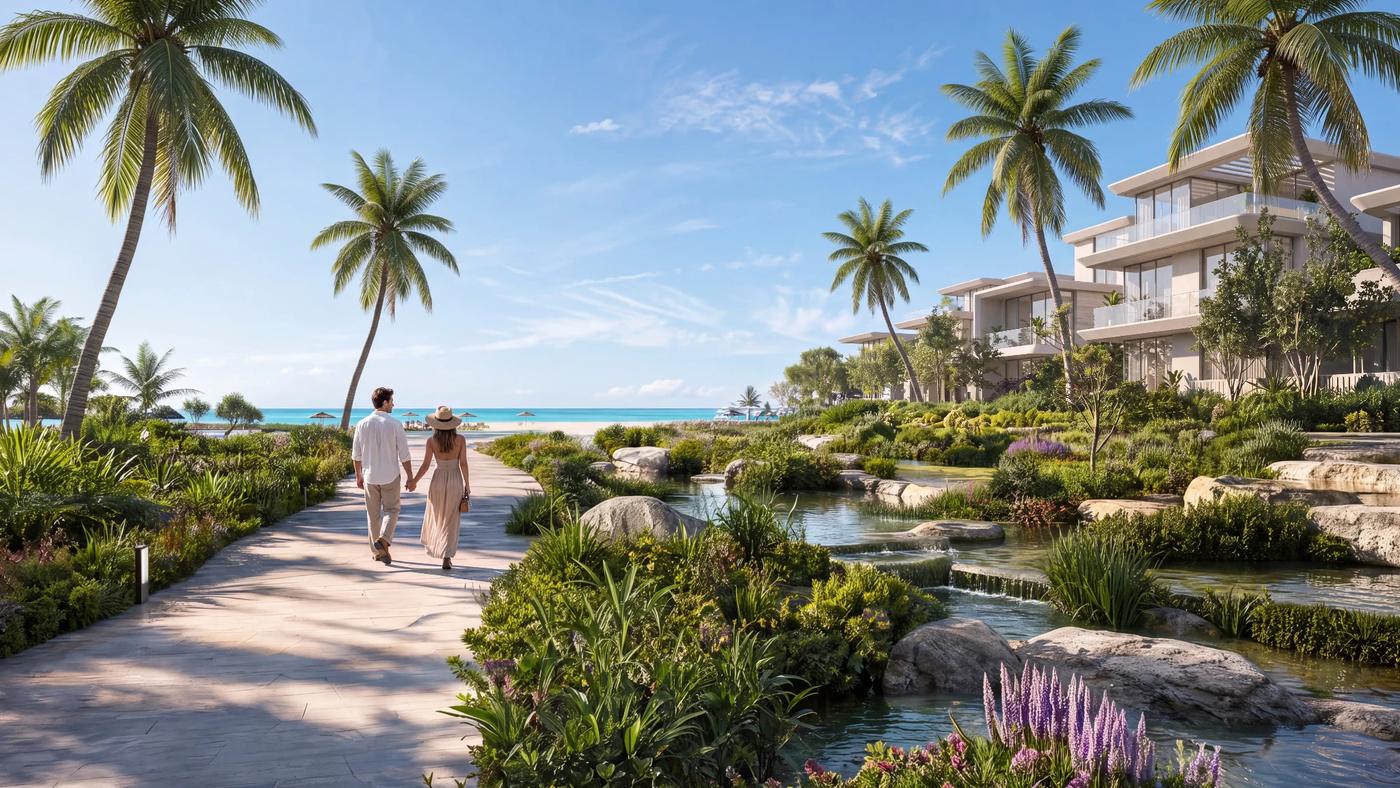
On 21 September 2026, Abu Dhabi-based developer Eagle Hills announced that it had signed a commercial terms agreement with the Government of the Maldives for a major integrated island destination in the Ras Malé area — Maldives Waterfront & Marina, envisioned at approximately USD 12 billion across its various phases. Rather than another standalone resort, the ambition is to combine residential ownership, hospitality, marina infrastructure, waterfront leisure, retail, dining, wellness and community facilities within a single destination. For international property investors, that distinction matters: this is not simply real estate beside a resort, but an attempt to build an entirely new waterfront ecosystem inside one of the world's strongest destination brands.
Quick Facts
A New Chapter for Maldives Real Estate
The Maldives has traditionally been viewed through one dominant investment lens: luxury tourism. Private islands, internationally branded resorts, overwater villas and high-end hospitality have established the country as one of the world's most distinctive travel destinations. Maldives Waterfront & Marina introduces a different proposition: an attempt to translate an already-global tourism brand into a broader residential and investment market, rather than create destination awareness from zero.
What Is Maldives Waterfront & Marina?
Maldives Waterfront & Marina is planned for Ras Malé, a major new urban area being developed around the Fushi Dhiggaru Lagoon near Malé. Data The Maldives government describes Ras Malé as the country's largest land reclamation initiative, with more than 1,100 hectares planned and a masterplan envisaging about 65,000 housing units island-wide — Eagle Hills' development is one component within that larger reclamation, not the whole of it.
Eagle Hills' announced plans for its own destination include:
- International hotels and resorts
- Premium and branded residences
- Serviced apartments and private villas
- A world-class marina
- Waterfront promenades
- Retail and dining
- Entertainment, wellness and sporting facilities
- Education and healthcare
- Community infrastructure and public spaces integrated around the waterfront
If delivered as envisioned, the result would sit considerably closer to an integrated waterfront city than a conventional Maldivian resort development.
Why Eagle Hills Matters

Eagle Hills is an Abu Dhabi-based private real estate investment and development company focused on large-scale mixed-use developments in international growth markets, with a portfolio spanning the UAE, Serbia, Albania, Morocco, Bahrain, Oman, Jordan and other countries. The company is chaired by Mohamed Alabbar, one of the best-known figures in large-scale real estate development originating from the UAE.
Data Speaking to The National at the signing in Dubai, Alabbar framed the rationale around length of stay rather than a new resort: “There's only one Maldives in the world… people go there and pay $4,000 a night. So why don't we give more people the chance to come and experience the Maldives, but for a longer period of time… where you can stay for one or two months or maybe one year.” He also said Eagle Hills “commits to the total value of its projects during the development period,” typically funded through a mix of equity, debt and property pre-sales, and that projects can stretch “10 years or 15 years.”
Large master developments ultimately depend not simply on individual buildings, but on whether the wider destination attracts residents, visitors, operators, businesses and capital over many years.
From Resort Destination to Residential Market
The Maldives receives global recognition as a holiday destination, but its international residential property market remains far less mature than markets such as Dubai, London or Singapore. That creates the central question behind this project: can one of the world's strongest luxury tourism brands successfully evolve into a meaningful international residential and second-home market?
If successful, the development could draw several distinct buyer profiles, each with different objectives — understanding which part of the development matches which objective matters more than comparing headline prices alone:
The Ownership Structure
Data Properties are expected to be offered through a long-term leasehold structure under Maldivian law, with terms of up to 99 years. In its own statement, Eagle Hills said: “Upon each transfer, whether through sale or inheritance, a new leasehold term of up to 99 years will commence, providing lasting continuity for owners across generations.”
This is materially different from purchasing freehold property in markets where ownership of the underlying real estate is perpetual. It does not automatically make the structure better or worse — it makes it different, and investors should understand exactly what they are purchasing. Before committing capital, buyers should independently verify the final lease documentation, transfer rights, inheritance treatment, registration procedures, service obligations, financing provisions and applicable taxation.
Accessibility
Market claim Eagle Hills' own project site describes the destination as 4–5 minutes from Velana International Airport by air, with the airport around 15 km away by seaplane. Data Separately, news coverage of the announcement describes the wider Ras Malé site as roughly 17 minutes from central Malé by speedboat — a different journey, to a different destination, so both figures are shown rather than reconciled into one.
Ras Malé sits within the economic orbit of Malé rather than as an isolated remote-island resort. A destination incorporating homes, education, healthcare, retail, marina infrastructure and everyday services has the potential to support a wider spectrum of residential use than traditional tourism-linked resort ownership.
Residences Currently Envisaged
Market claim Per the developer's own project site, the residential mix currently on offer for registration includes:
| Category | Configurations |
|---|---|
| Serviced Apartments | 1, 2 & 3 bedroom |
| Apartments | 1, 2 & 3 bedroom |
| Villas | ~250 sq m, ~350 sq m, 400+ sq m |
The site also refers to professional servicing, maintenance and dedicated leasing management on the serviced categories. These distinctions matter: a serviced apartment positioned for managed short stays should not be evaluated with the same assumptions as a large private waterfront villa intended primarily for personal occupation. Zen Homes will assess individual releases on their actual commercial proposition rather than treating the entire master development as one investment product.
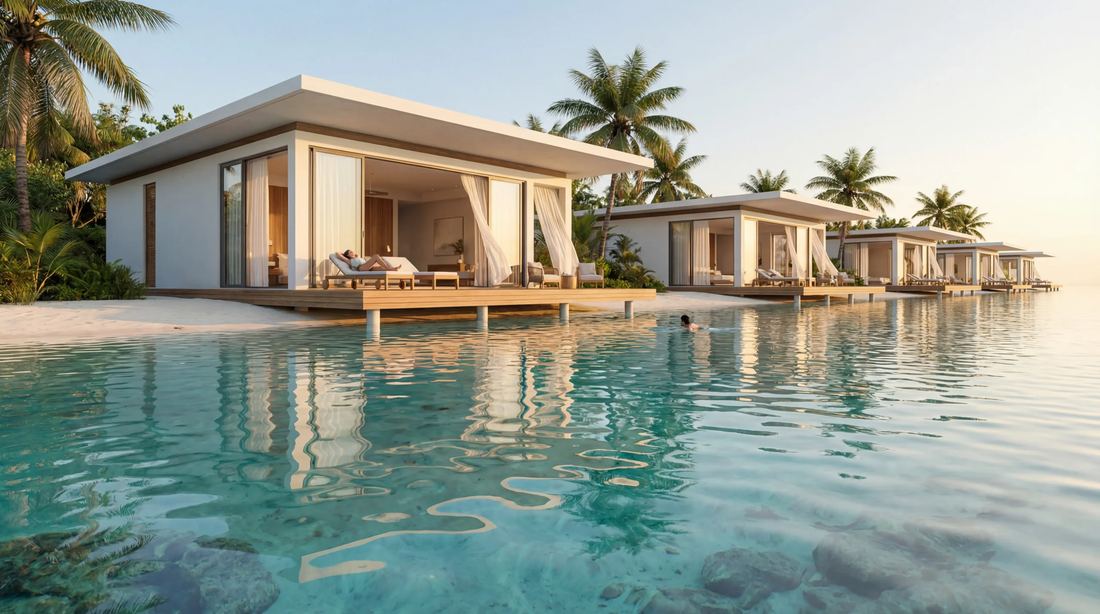
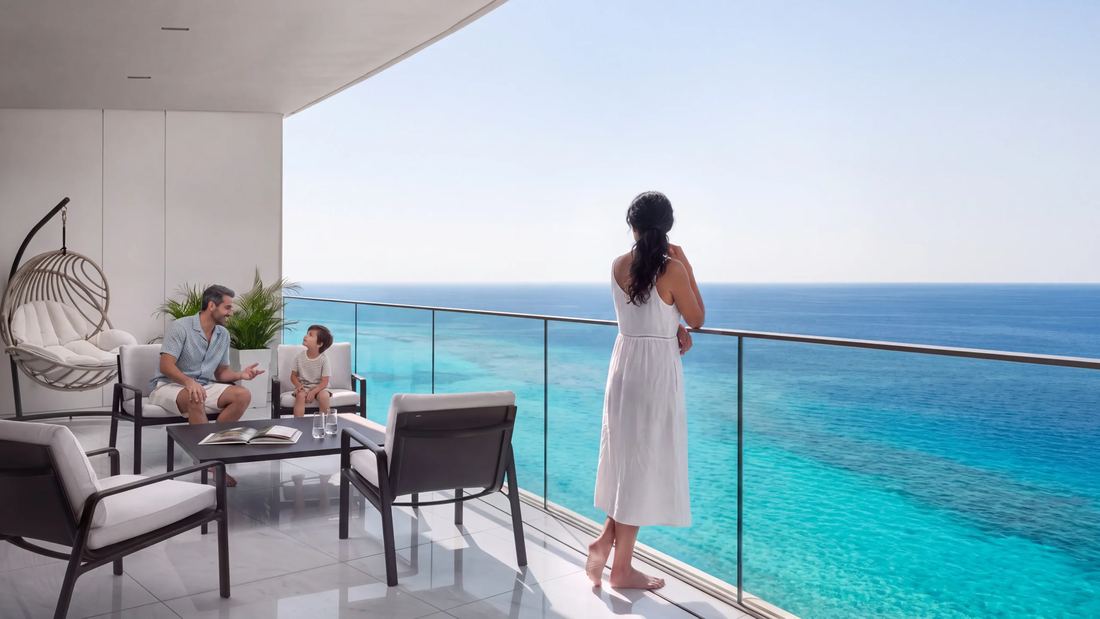
Renders published by Eagle Hills on the official Maldives Waterfront & Marina project site. Eagle Hills' own disclaimer: "All images are artist's impressions and subject to change."
Marina-Led Waterfront Living
One of the more distinctive components of the project is the proposed marina. Marina developments can create a different economic ecosystem from conventional resort developments, supporting restaurants, retail, leisure, marine services and yacht activity that extend the destination beyond the traditional hotel guest. Eagle Hills' own site groups its planned waterfront amenities into six categories: Entertainment, Marina, Retail/F&B, Sports, Wellness and Beach.
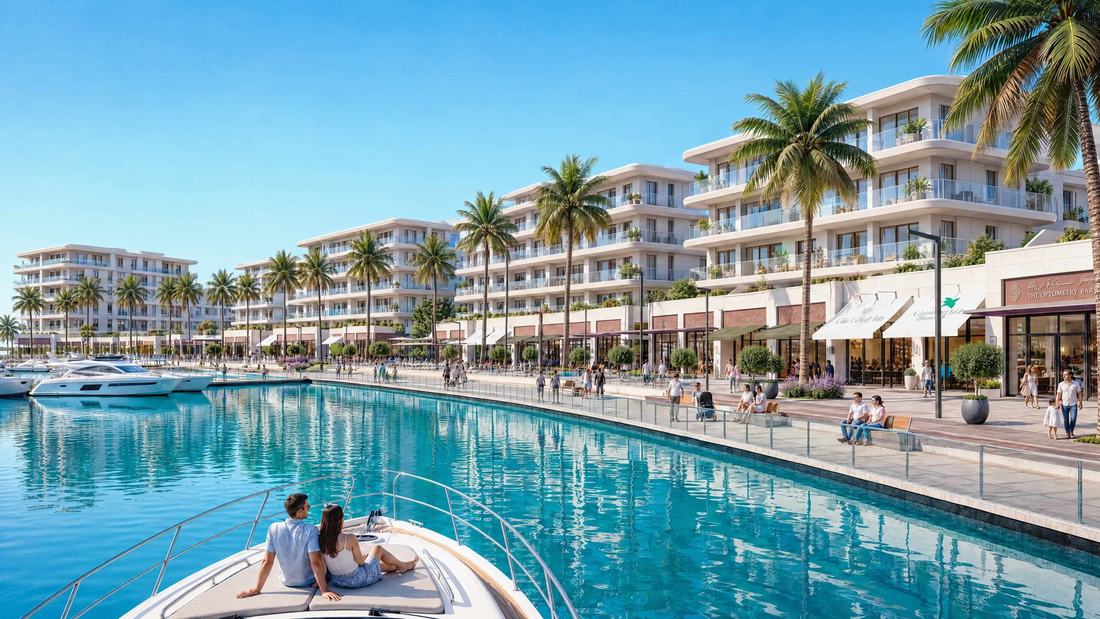
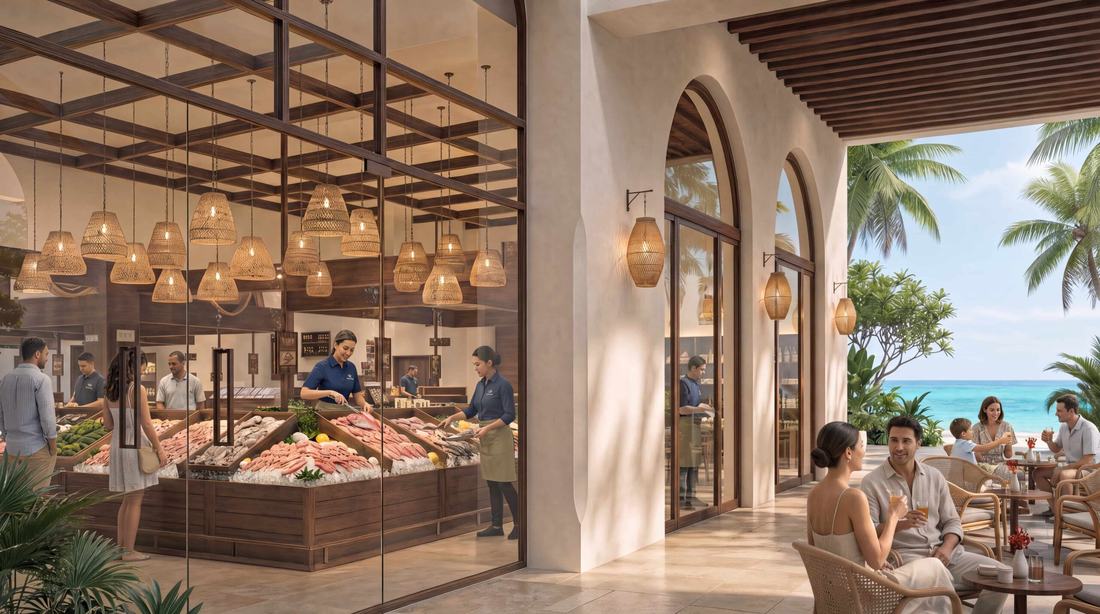

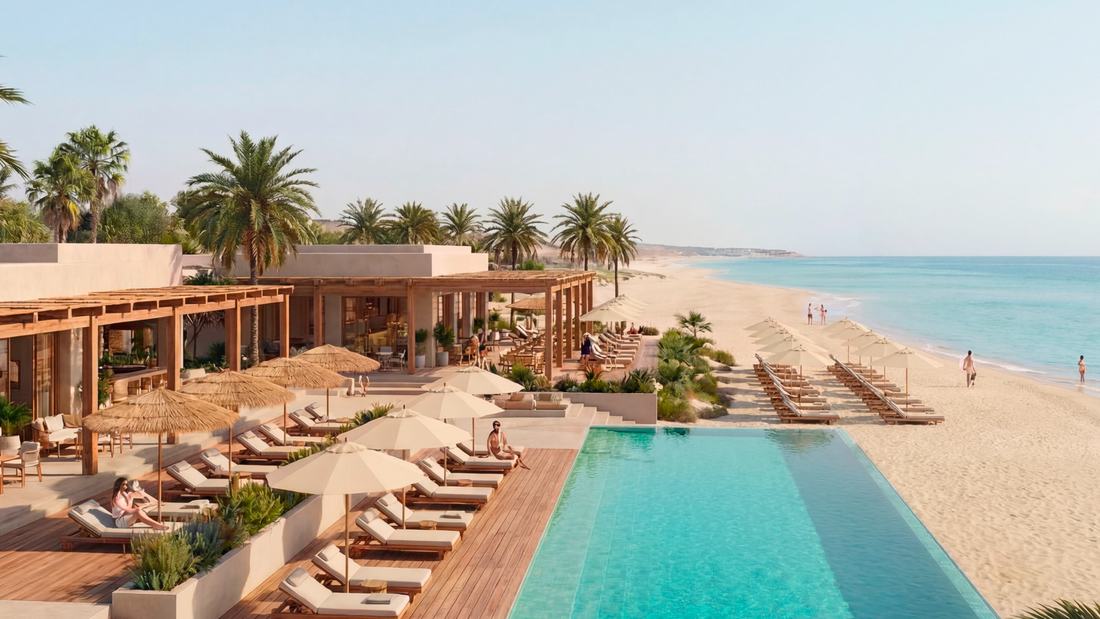
Renders published by Eagle Hills on the official Maldives Waterfront & Marina project site. Eagle Hills' own disclaimer: "All images are artist's impressions and subject to change." Of the six waterfront categories the developer presents, four (Marina, Retail/F&B, Wellness, Beach, shown above) are illustrated with project-specific architectural renders. The remaining two — Entertainment and Sports — are currently illustrated on the developer's own site with generic reference photography rather than renders of this development, which we have not reproduced here for that reason.
The Broader Economic Vision
The Maldivian government is presenting the project as more than a property development. Data Maldives Infrastructure Minister Abdulla Muththalib called it “the largest investment programme in our history,” adding that the state would earn “direct revenue from every sale” achieved “without tax giveaways and without government borrowing,” and framed it as part of an ambition to become “a high-income country by 2040.”
Data Eagle Hills has cited preliminary estimates that the project could attract more than USD 30 billion in gross foreign investment over its lifetime, including about USD 18 billion in net foreign investment in the Maldives — both larger and distinct figures from the USD 12 billion envisioned development value. The company also projects the development will create more than 54,000 direct and indirect jobs and, at full maturity, attract over one million visitors annually while generating more than USD 2 billion in yearly tourism revenue.
Whether Ras Malé achieves that diversification will ultimately depend on execution, infrastructure, international demand and the pace at which the wider destination develops.
A residency route worth knowing about
Data Eagle Hills' own project site markets the Maldives Corporate Resident Visa: five years' residency, renewable, for a qualifying investment from USD 250,000, with a one-time fee paid only once the visa is approved. This is a genuine, independently documented Maldivian government programme — parliament-approved, with routes including a USD 250,000 fixed bank deposit or a USD 250,000 investment in government-approved projects. Some independent reporting suggests its terms have been under review, so confirm current eligibility, and whether a specific unit purchase here actually qualifies, before relying on it.
Environmental Considerations
Any development of this scale in the Maldives inevitably raises environmental considerations. The Maldives possesses an unusually sensitive marine ecosystem, so environmental execution should form part of any serious assessment of the project. Data Eagle Hills states the project will be developed on reclaimed land, with no further dredging to be undertaken, and that independent marine monitoring will accompany construction. Alabbar told The National: “We have to be honest, and respect the people and the environment… we are going to do that carefully,” citing “respecting the turtles and the fish and the corals.”
For investors, these commitments should be monitored as the project moves from announcement into detailed planning and construction. Environmental performance in the Maldives is not merely an ESG consideration — the natural environment is itself one of the principal economic assets supporting property and tourism demand.
What Makes the Opportunity Interesting?
1. A Globally Recognised Destination
The Maldives does not need to establish international tourism awareness — its destination brand already exists. The investment question is whether that recognition can translate into sustained residential ownership demand.
2. Scale
An envisioned development value of approximately USD 12 billion makes this significantly larger than a conventional standalone resort or residential project. Scale can create infrastructure, amenities and destination gravity — it also introduces execution and phasing risk.
3. Integrated Demand
Hotels, residences, marina facilities, retail, restaurants, wellness, entertainment and community infrastructure are intended to coexist. If successfully executed, those components can reinforce one another.
4. UAE Development Expertise
The involvement of an Abu Dhabi-headquartered international developer introduces experience from a region with considerable expertise in creating large waterfront and master-planned communities.
5. An Emerging Property Market
The Maldives residential investment market is far less established than mature international property markets. Early-stage markets can create opportunities; they also contain considerably less historical evidence from which investors can estimate resale liquidity, rental performance and long-term price behaviour. Both sides of that equation matter.
The Questions Investors Should Ask
A USD 12 billion headline should never be the reason to invest. For sophisticated buyers, the more important questions begin after the announcement:
- What is the launch price relative to comparable international resort and waterfront markets?
- What exactly does the leasehold title provide?
- What are the service and management charges?
- How will rental management operate, and what percentage of revenue does the operator retain?
- Are there restrictions on personal use?
- What is the expected construction and handover schedule?
- Which hospitality brands will operate within the development?
- What infrastructure will exist when the first residences are handed over?
- How many competing units will ultimately enter the market?
- What does the secondary resale process look like?
- What taxes, government fees and transaction costs apply?
- Who will the next buyer be?
That final question is routinely overlooked in off-plan property investment. A beautiful property can still be a weak investment if the future buyer pool is narrow.
What Is Not Yet Known
Investors should distinguish clearly between the announced master vision and the commercial details of individual investment opportunities. The September 2026 announcement concerns a commercial terms agreement between Eagle Hills and the Government of the Maldives. It establishes the project's broad vision and principal commercial terms; detailed terms are expected to develop as the project progresses, and no construction timeline or phasing has been disclosed.
The USD 12 billion figure represents the envisioned overall development scale across multiple phases. It should not be interpreted as USD 12 billion of capital already deployed, or as a guarantee that every component of the proposed masterplan will be delivered exactly as currently envisaged. Detailed information on individual residential releases, final pricing, payment plans, construction schedules, branded-residence operators, service charges and projected investment economics should be evaluated when formally released — not extrapolated from launch announcements.
Is This the Right Fit?
This suits an investor comfortable acting at the vision stage of a large, phased master development — drawn to the combination of a globally recognised destination brand, UAE master-development expertise, and early access ahead of formal pricing. It is not suited to a buyer who needs a confirmed unit price, payment schedule, rental structure or handover date today: none of those exist yet for this project. Leasehold buyers in particular should be comfortable with a title structure that differs from perpetual freehold ownership before proceeding.
How we can help
If you're considering Maldives Waterfront & Marina, our review can include: developer and masterplan review; property and pricing analysis once units release; ownership structure and cost review (transaction costs, recurring charges, key commercial conditions); a rental and investment assessment based on realistic positioning rather than headline projections; exit and resale analysis, including the likely future buyer pool; and, where available, independent property inspection and snagging, plus turnkey support from acquisition to a completed, investment-ready property.
Is Maldives Waterfront & Marina freehold?
No. Eagle Hills states properties will be sold on a long-term leasehold basis under Maldivian law, for terms of up to 99 years, with a new up-to-99-year term starting on each transfer by sale or inheritance. This is materially different from perpetual freehold ownership — verify the final lease documentation before committing.
How much does Maldives Waterfront & Marina cost, and what can I buy?
No unit pricing has been released. The September 2026 announcement covers a commercial terms agreement and the overall USD 12 billion envisioned development value, not individual residence prices. The developer's own site lists a residential mix of 1–3-bedroom serviced apartments, 1–3-bedroom apartments, and villas of roughly 250 sq m, 350 sq m and 400+ sq m — pricing for each is expected to follow as the project moves from vision to release.
Is the USD 12 billion figure capital already invested?
No. It is Eagle Hills' envisioned overall development value across multiple phases, not capital already deployed or a guarantee every component of the masterplan will be delivered as currently envisaged. Separately, Eagle Hills has cited preliminary estimates of over USD 30 billion in gross foreign investment and about USD 18 billion in net foreign investment over the project's lifetime — a different, larger figure describing a different thing.
Does buying at Ras Malé qualify for Maldivian residency?
Eagle Hills' own project site markets the Maldives Corporate Resident Visa — five years' residency, renewable, for investments from USD 250,000, including a route via investment in government-approved projects. The programme itself is independently confirmed and government-approved, but reporting suggests its terms have been under review, so confirm current eligibility and whether a specific unit purchase qualifies before relying on it.
How far is Maldives Waterfront & Marina from the airport?
The project's own site states 4–5 minutes from Velana International Airport by air (seaplane/speedboat transfer), with the airport about 15 km away. Separately, news coverage describes the wider Ras Malé site as roughly 17 minutes from central Malé by speedboat — a different journey, to a different destination.